
Chevrolet Sonic Repair Manual: Cooling System Draining and Filling
- Draining Procedure
-
- Remove the coolant pressure cap from the radiator surge tank.
- Raise and support the vehicle. Refer to Lifting and Jacking the Vehicle.
- Remove the front compartment front insulator cover. Refer to Front Compartment Front Insulator Cover Replacement.
- Place a drain pan under the drain cock.
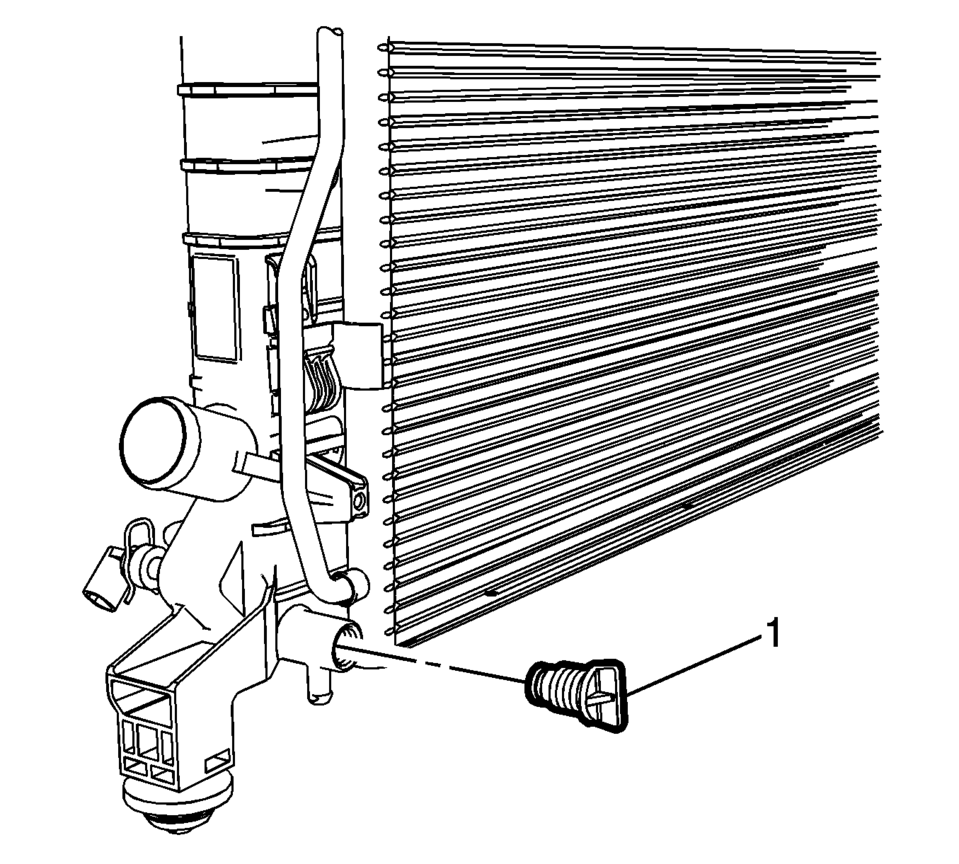
- Loosen the radiator drain cock (1).
- Drain the cooling system.
- Lower the vehicle.
- Inspect the coolant.
- Follow the appropriate procedure based on the condition of the coolant.
Warning:
To avoid being burned, do not remove the radiator cap or surge tank cap while the engine is hot. The cooling system will release scalding fluid and steam under pressure if radiator cap or surge tank cap is removed while the engine and radiator are still hot.
- Normal in appearance—Follow the filling procedure.
- Discolored—Follow the flush procedure. Refer to Coolant System Flushing.
- Filling Procedure
-
- Raise and support the vehicle.
- Tighten the radiator drain cock (1) to 2 Y (18 lb in)
.
- Install the front compartment front insulator cover. Refer to Front Compartment Front Insulator Cover Replacement.
- Lower the vehicle.
- Slowly fill the radiator with a 50/50 coolant mixture until the coolant level reaches the base of the radiator surge tank. Refer to Approximate Fluid Capacities.
- Allow 30 seconds for the coolant level to stabilize and continue to fill the coolant filler neck until the level stabilizes for at least 2 minutes.
- Start the engine and allow to the engine to idle in PARK or NEUTRAL with the parking brake engaged.
- Slowly fill the coolant mixture until the level stabilizes at the base of the radiator surge tank.
- Install the coolant pressure cap.
- Raise the engine RPM to 2500 rpm for 30?E0 seconds.
- Shut the engine OFF.
- Allow the engine to cool, remove coolant fill cap and repeat steps 4?E0 until the coolant level has completely stabilized within the radiator surge tank.
- Inspect and if necessary, fill the coolant reservoir bottle as necessary.
- Rinse away any excess coolant from the engine and the engine compartment.
- Inspect the cooling system for leaks.
- Top off the radiator surge tank if necessary.
Caution:
The procedure below must be followed. Improper coolant level could result in a low or high coolant level condition, causing engine damage.
Caution:
Refer to Fastener Caution.
Note:
Use a 50/50 mixture of DEX-COOL antifreeze and clean drinkable water.
 Cooling System Description and Operation
Cooling System
The cooling system maintains the engine operating temperature at the efficient
level under any speed and operating condition. When the engine is cold, the
cooling system ...
 Engine Coolant Air Bleed Hose Replacement (LUV)
Engine Coolant Air Bleed Hose Replacement
Callout
Component Name
1
Engine Coolant Air Bleed Hose Clamp (Qty: 2)
...
Other materials:
Transmission Fluid Cooler Hose/Pipe Quick-Connect Fitting Disconnection and
Connection
Removal Procedure
Note: Perform the following procedure when removing the retaining
rings and cooler lines from the quick connect fittings located on the
radiator and/or the transmission.
Pull the plastic cap back from the quick connect fitting
and dow ...
Transmission System Description and Operation
The F17 is a 5 speed manual transmission assembly.
Note: Use only transmission fluid listed within the
Adhesives, Fluids, Lubricants, and Sealers for
this manual transmission assembly. Other lubricants or additives may affect
the shift performance.
The F17 (Gen 1) 5 Speed m ...
Battery
Basic information
On the Nissan Armada, batteries labeled "do not open" are fully maintenance-free,
meaning the internal electrolyte level does not require inspection. For accurate
diagnostics and performance checks, it is strongly recommended to consult an
authorized NISS ...

0.0076