
Chevrolet Sonic Owner's Manual: When It Is Time for New Tires
Factors such as maintenance, temperatures, driving speeds, vehicle loading, and road conditions affect the wear rate of the tires.
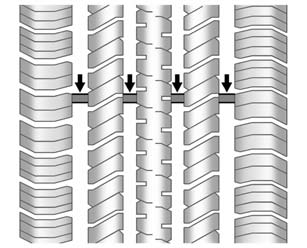
Treadwear indicators are one way to tell when it is time for new tires. Treadwear indicators appear when the tires have only 1.6mm (1/16 in) or less of tread remaining. See Tire Inspection and Tire Rotation.
The rubber in tires ages over time. This also applies to the spare tire, if the vehicle has one, even if it is never used. Multiple factors including temperatures, loading conditions, and inflation pressure maintenance affect how fast aging takes place. GM recommends that tires, including the spare if equipped, be replaced after six years, regardless of tread wear. The tire manufacturer date is the last four digits of the DOT Tire Identification Number (TIN) which is molded into one side of the tire sidewall. The first two digits represent the week (01–52) and the last two digits, the year. For example, the third week of the year 2010 would have a four-digit DOT date of 0310.
Vehicle Storage
Tires age when stored normally mounted on a parked vehicle. Park a vehicle that will be stored for at least a month in a cool, dry, clean area away from direct sunlight to slow aging. This area should be free of grease, gasoline, or other substances that can deteriorate rubber.
Parking for an extended period can cause flat spots on the tires that may result in vibrations while driving. When storing a vehicle for at least a month, remove the tires or raise the vehicle to reduce the weight from the tires.
 Tire Rotation
Tires should be rotated every 12 000 km (7,500 mi). See Maintenance Schedule.
Tires are rotated to achieve a uniform wear for all tires. The first rotation
is the most important.
Anytime unusual w ...
 Buying New Tires
GM has developed and matched specific tires for the vehicle. The original equipment
tires installed were designed to meet General Motors Tire Performance Criteria Specification
(TPC Spec) system r ...
Other materials:
Delayed Locking
This feature delays the actual locking of the doors until five seconds after
all doors are closed. Delayed locking can only be turned on when the Unlocked Door
Anti Lockout feature has been turned off.
When is pressed on the driver or
passenger door power lock switch while the door is open, ...
Vehicle, Engine and Transmission ID and VIN Location, Derivative and Usage
The vehicle identification number (VIN) plate is the legal identifier of the
vehicle. The VIN plate is located on the upper left corner of the instrument panel
(I/P) and can be seen through the windshield from the outside of the vehicle:
Vehicle, Engine and Transmission ID and VIN Loca ...
Rear-facing child restraint installation using the seat belts
WARNING
When installing a rear-facing child restraint in the Nissan Armada, the
three-point seat belt must be switched to Automatic Locking Retractor (ALR)
mode.
Failure to activate ALR mode may result in the child restraint not being
securely fixed. This could cause the seat to sh ...

0.0084