
Chevrolet Sonic Repair Manual: Drive Range, Second Gear (Gen 1)
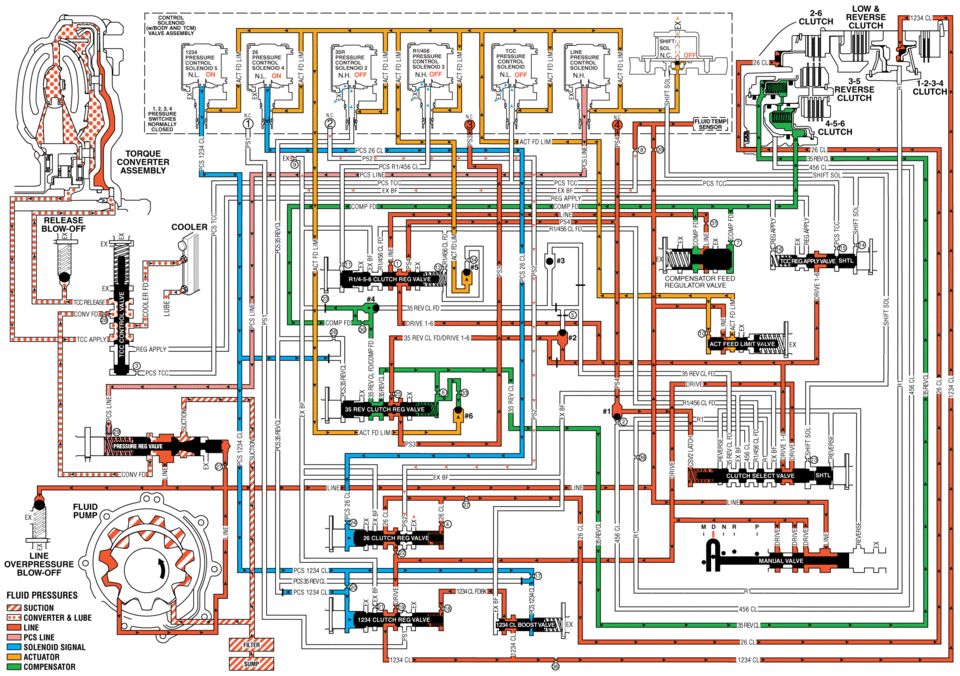
As vehicle speed increases and operating conditions become appropriate, the transmission control module (TCM) processes input signals from the automatic transmission input and output speed sensors, the throttle position sensor and other vehicle sensors to determine the precise moment to command ON the normally-low 2-6 pressure control solenoid 4 and shift the transmission into Second gear. The manual valve remains in the Drive (D) position and line pressure continues to feed the drive fluid circuit.
- 2-6 Clutch Applies
-
26 Pressure Control (PC) Solenoid 4
The 26 PC solenoid 4 is commanded ON, allowing actuator feed limit fluid to enter the PCS 26 clutch fluid circuit. PCS 26 clutch fluid is then routed through orifice #24 to the 2-6 clutch regulator valve.
2-6 Clutch Regulator Valve
PCS 26 clutch fluid, at the 2-6 clutch regulator valve, opposes 2-6 clutch regulator valve spring force and orificed 26 clutch fluid pressure to regulate drive fluid pressure into the 26 clutch circuit. 26 clutch fluid is then routed through orifice #37 to the 2-6 clutch assembly in the transmission case, and through orifice #4 to the spring end of the 2-6 clutch regulator valve. With the 2-6 clutch regulator valve in this position, PS2 fluid is allowed to exhaust and the normally-closed PS2 switch closes.
2-6 Clutch
The 26 clutch fluid from the 2-6 clutch regulator valve is routed through the transmission case to the 2-6 clutch piston assembly. The 26 clutch fluid pressure moves the piston against 2-6 clutch spring force to apply the 2-6 clutch plates.
- Drive Range, Second Gear
low reverse cl clutch pressure pressure convrol nl on n.h nh on: nl clutch act fd um torque cl converter assemblv pcs ex bf -comp release pcs tdc cooler compensator feed regulator valve sol blow-off fluid pressures suction converter lube line pcs line solenoid actuator compensatdr
 Drive Range, First Gear Engine Braking (Gen 2)
Note: Some models of the 6T30/40/45/50 automatic transmission are equipped with
an electric auxiliary fluid pump for use in hybrid vehicles (BAS+). Hybrid vehicles
do not require internal combusti ...
 Drive Range, Second Gear (Gen 2)
As vehicle speed increases and operating conditions become appropriate, the transmission
control module (TCM) processes input signals from the automatic transmission input
and output speed sensors ...
Other materials:
SIR Service Precautions
General Service Instructions
Warning: When performing service on or near the SIR components
or the SIR wiring, the SIR system must be disabled. Refer to SIR Disabling
and Enabling . Failure to observe the correct procedure could cause deployment
of the SIR components, person ...
Radiator Mounting Stud Repair
Repair Procedure
Note: If the radiator is leaky, replace it. Refer to Radiator
Replacement.
Pressure test the cooling system. Refer to Cooling System Leak Testing.
Grind the fracture surface (1) with a proper tool.
Drill a hole in the cente ...
System temporarily unavailable
Condition A
When driving the Nissan Armada, external radar interference from other vehicles
or surrounding sources may disrupt the radar sensor’s ability to accurately detect
vehicles ahead. In such situations, the Intelligent Forward Collision Warning (I-FCW)
system will automatically deac ...

0.0072