
Chevrolet Sonic Repair Manual: Drive Range, Second Gear (Gen 2)
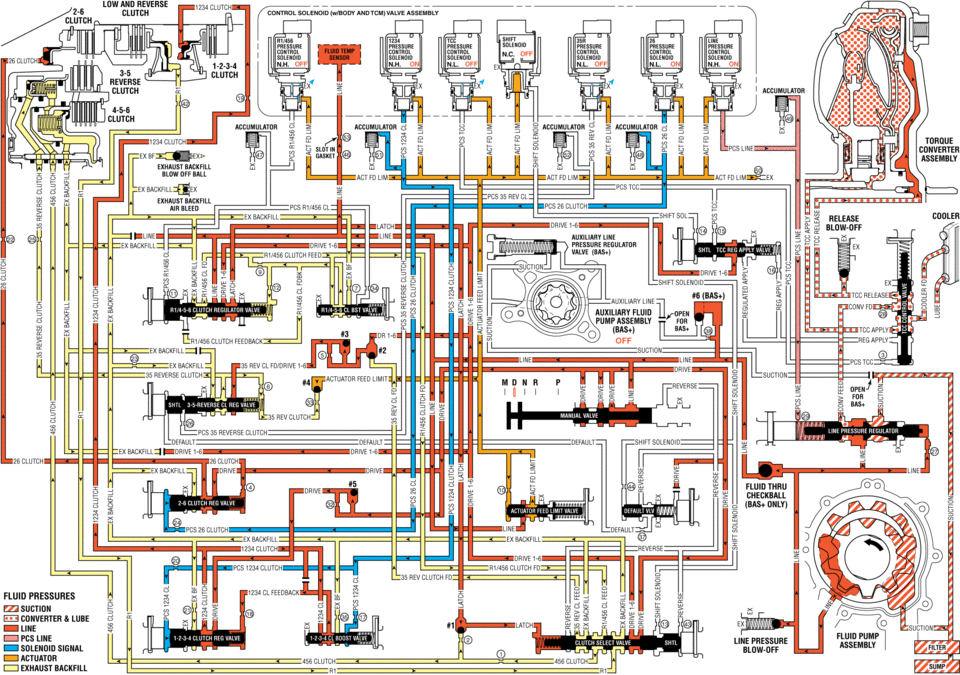
As vehicle speed increases and operating conditions become appropriate, the transmission control module (TCM) processes input signals from the automatic transmission input and output speed sensors, the throttle position sensor and other vehicle sensors to determine the precise moment to command ON the normally-low 26 pressure control solenoid and shift the transmission into Second gear. The manual valve remains in the Drive (D) position and line pressure continues to feed the drive fluid circuit.
- 2-6 Clutch Applies
-
26 Pressure Control (PC) Solenoid
The 26 PC solenoid is commanded ON, allowing actuator feed limit fluid to enter the PCS 26 clutch fluid circuit. PCS 26 clutch fluid is then routed through orifice #24 to the 2-6 clutch regulator valve.
2-6 Clutch Regulator Valve
PCS 26 clutch fluid, at the 2-6 clutch regulator valve, opposes 2-6 clutch regulator valve spring force and orificed 26 clutch fluid pressure to regulate drive fluid pressure into the 26 clutch circuit. 26 clutch fluid is then routed through orifice #22 to the 2-6 clutch assembly in the transmission case, and through orifice #4 to the spring end of the 2-6 clutch regulator valve.
2-6 Clutch
The 26 clutch fluid from the 2-6 clutch regulator valve is routed through the transmission case to the 2-6 clutch piston assembly. The 26 clutch fluid pressure moves the piston against 2-6 clutch spring force to apply the 2-6 clutch plates.
Accumulator
PCS 26 clutch fluid is also routed to an accumulator valve. The accumulator valve is used to dampen any pressure irregularities occurring in the PCS 26 clutch fluid circuit. This helps to control clutch apply fluid pressure and clutch apply feel.
- Drive Range, Second Gear ?#8201;Gen 2/Hybrid
solenijid valve assembly ms pres pre press pressure n.h. off off off clutch accnmuumn clutch tdrdue converter assemnlv exhaust ex ex backhll release cddleh at blow-off ex valve mc release auxiliary fluid pumpassembly (bas+) clutch feedback off ex ii sucnuu h_ sun ree ..... 35 rev clutch pcs reverse default sulenoid :ex -drive drive 25 fluid mu ehedkball feed pcszg clutch ex reverse fluid pnessunes sucnou lube lime line pressure solenoid signal 1_ clutch clutch :i exhaust backfill ,, ,,
 Drive Range, Second Gear (Gen 1)
As vehicle speed increases and operating conditions become appropriate, the transmission
control module (TCM) processes input signals from the automatic transmission input
and output speed sensors ...
 Drive Range, Sixth Gear (Gen 1)
As vehicle speed increases, the transmission control module (TCM) processes input
signals from the automatic transmission input and output speed sensors, the throttle
position sensor and other veh ...
Other materials:
Washer Fluid
Open the cap with the washer symbol on it. Add washer fluid until the tank is
full. See Engine Compartment Overview for reservoir location.
Caution
. Do not use engine coolant (antifreeze) in the windshield washer. It
can damage the windshield washer system and paint.
. Do not mi ...
Body Rear Seat Back Trim Panel Replacement (with AMA/AM7)
Body Rear Seat Back Trim Panel Replacement
Callout
Component Name
Preliminary Procedure
Remove the body side trim panel. Refer to Body Side Trim Panel Replacement.
1
Body Rear Seat Back Trim Pane ...
Top tether anchor
2nd row captain's seat
2nd row bench seat
3rd row seat
Basic information
The Nissan Armada is equipped with dedicated top tether anchor points designed
to enhance child restraint stability and safety. When a child restraint system includes
a top tether strap, it must always b ...

0.0061