
Chevrolet Sonic Repair Manual: Drive Range, Sixth Gear (Gen 1)
As vehicle speed increases, the transmission control module (TCM) processes input signals from the automatic transmission input and output speed sensors, the throttle position sensor and other vehicle sensors to determine the precise moment to command ON the normally-low 26 pressure control solenoid 4. At the same time, the normally-high 35R pressure control solenoid 2 is commanded OFF and the transmission shifts into Sixth gear.
- 2-6 Clutch Applies
-
26 Pressure Control (PC) Solenoid 4
The 26 PC solenoid 4 is commanded ON, allowing actuator feed limit fluid to enter the PCS 26 clutch fluid circuit. PCS 26 clutch fluid is then routed through orifice #24 to the 2-6 clutch regulator valve.
2-6 Clutch Regulator Valve
PCS 26 clutch fluid, at the 2-6 clutch regulator valve, opposes 2-6 clutch regulator valve spring force and orificed 26 clutch fluid pressure to regulate drive fluid pressure into the 26 clutch circuit. 26 clutch fluid is then routed through orifice #37 to the 2-6 clutch assembly in the transmission case, and through orifice #4 to the spring end of the 2-6 clutch regulator valve. With the 2-6 clutch regulator valve in this position, PS2 fluid is allowed to exhaust and the normally-closed PS2 switch closes.
2-6 Clutch
The 26 clutch fluid from the 2-6 clutch regulator valve is routed through the transmission case to the 2-6 clutch piston assembly. The 26 clutch fluid pressure moves the piston against 2-6 clutch spring force to apply the 2-6 clutch plates.
- 3-5 Reverse Clutch Releases
-
35R Pressure Control (PC) Solenoid 2
The 35R PC solenoid 2 is commanded OFF allowing PCS 35 reverse clutch fluid from the 3-5-reverse clutch regulator valve to exhaust.
3-5-Reverse Clutch Regulator Valve
PCS 35 reverse clutch fluid exhausts, allowing 3-5-reverse clutch regulator valve spring force to move the 3-5-reverse clutch regulator valve to the released position. This allows 35 reverse clutch fluid pressure to exhaust into the compensator feed circuit in order to assist the 3-5-reverse clutch piston spring to quickly release the 3-5-reverse clutch. With the 3-5-reverse clutch regulator valve in this position, orificed (#25) 35 reverse clutch feed/drive 1-6 fluid passes through the valve into the PS3 circuit. PS3 fluid is routed to the normally-closed #3 pressure switch and opens the switch.
3-5-Reverse Clutch
3-5-reverse clutch spring force, assisted by compensator feed pressure, moves the 3-5-reverse clutch piston to release the 3-5- reverse clutch plates and force 35 reverse clutch fluid to exhaust from the 3-5-reverse and 4-5-6 clutch housing assembly. The exhausting 35 reverse clutch fluid pressure is routed to the 3-5- reverse clutch regulator valve where it enters the 35 reverse clutch feed/compensator feed circuit.
- Drive Range, Sixth Gear
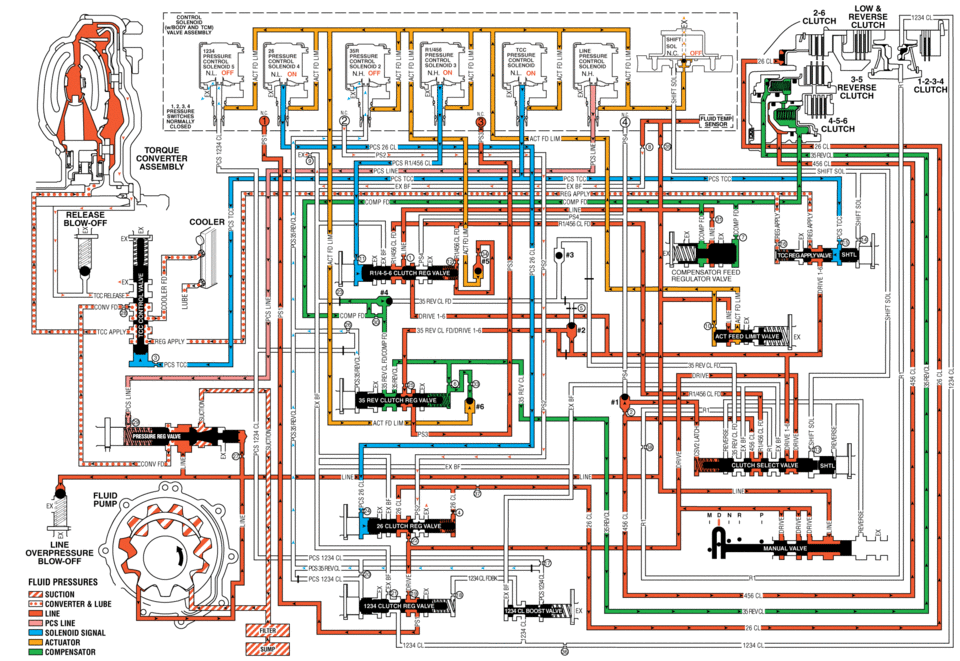
reverse clutch .. camrrol comrrol cl solenoid solenoid nl on n.h nh. reverse clutch clutch tohoue converter assembly in fielease compensator feed drne line overpressure pcs cl fluid pressures suction converter lube line line solenoid actuator low
 Drive Range, Second Gear (Gen 2)
As vehicle speed increases and operating conditions become appropriate, the transmission
control module (TCM) processes input signals from the automatic transmission input
and output speed sensors ...
 Drive Range, Sixth Gear (Gen 2)
As vehicle speed increases, the transmission control module (TCM) processes input
signals from the automatic transmission input and output speed sensors, the throttle
position sensor and other veh ...
Other materials:
How to Add Coolant to the Coolant Surge Tank
Caution
This vehicle has a specific coolant fill procedure. Failure to follow this
procedure could cause the engine to overheat and be severely damaged.
If no problem is found, check to see if coolant is visible in the coolant surge
tank. If coolant is visible but the coolant level is not at t ...
Rear Side Door Upper Front Auxiliary Weatherstrip Retainer Replacement
Rear Side Door Upper Front Auxiliary Weatherstrip Retainer Replacement
Callout
Component Name
1
Front Side Door Upper Front Auxiliary Weatherstrip Retainer (Qty:?€‰10)
Note: If the retainers are damaged when ...
Water Inlet Replacement (LUW)
Removal Procedure
Drain the engine coolant system. Refer to Cooling System Draining and
Filling.
Disconnect the engine coolant temperature sensor connector (1).
Remove the radiator outlet hose connector clip (2) and the radiator
outlet hose ...

0.0101