
Chevrolet Sonic Owner's Manual: Lap-Shoulder Belt
All seating positions in the vehicle have a lap-shoulder belt.
The following instructions explain how to wear a lap-shoulder belt properly.
1. Adjust the seat, if the seat is adjustable, so you can sit up straight. To see how, see “Seats� in the Index.
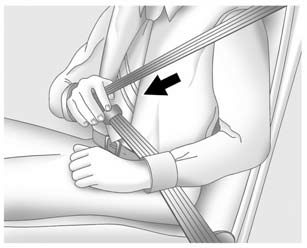
2. Pick up the latch plate and pull the belt across you. Do not let it get twisted.
The lap-shoulder belt may lock if you pull the belt across you very quickly. If this happens, let the belt go back slightly to unlock it. Then pull the belt across you more slowly.
If the shoulder portion of a passenger belt is pulled out all the way, the child restraint locking feature may be engaged. If this happens, let the belt go back all the way and start again.
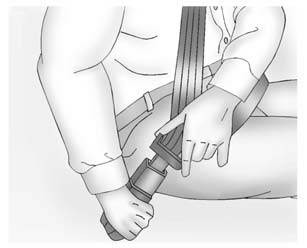
3. Push the latch plate into the buckle until it clicks.
If the latch plate will not go fully into the buckle, check if the correct buckle is being used.
Pull up on the latch plate to make sure it is secure. If the belt is not long enough, see Safety Belt Extender.
Position the release button on the buckle so that the safety belt could be quickly unbuckled if necessary.
4. If equipped with a shoulder belt height adjuster, move it to the height that is right for you. See “Shoulder Belt Height Adjuster� in this section for instructions on use and important safety information.
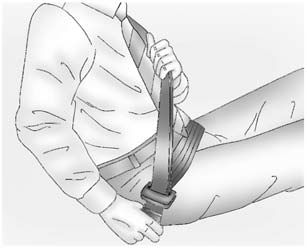
5. To make the lap part tight, pull up on the shoulder belt.
It may be necessary to pull stitching on the safety belt through the latch plate to fully tighten the lap belt on smaller occupants.
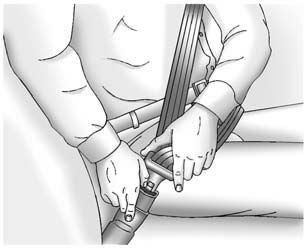
To unlatch the belt, push the button on the buckle. The belt should return to its stowed position.
Before a door is closed, be sure the belt is out of the way. If a door is slammed against a safety belt, damage can occur to both the safety belt and the vehicle.
 How to Wear Safety Belts Properly
This section is only for people of adult size.
There are special things to know about safety belts and children. And there are
different rules for smaller children and infants. If a child will be r ...
 Shoulder Belt Height Adjuster
The vehicle has a shoulder belt height adjuster for the driver and right front
passenger seating positions.
Adjust the height so the shoulder portion of the belt is on the shoulder and
not fallin ...
Other materials:
Heated Front Seats
Warning
If you cannot feel temperature change or pain to the skin, the seat heater
may cause burns. To reduce the risk of burns, people with such a condition should
use care when using the seat heater, especially for long periods of time. Do not
place anything on the seat that insulates again ...
Front Side Door Outer Panel Replacement
Removal Procedure
Note: According to different corrosion warranties, only the regional
mandatory joining methods are allowed.
Disable the SIR System. Refer to SIR Disabling and Enabling.
Disconnect the negative battery cable. Refer to Battery Negative Cable
Disconn ...
All Seasons Tires Description
Most GM vehicles are equipped with steel belted all-season radial tires as standard
equipment. These tires qualify as snow tires, with a higher than average rating
for snow traction than the non-all season radial tires previously used. Other performance
areas, such as wet traction, rolling ...

0.0099