
Chevrolet Sonic Owner's Manual: Tire Rotation
Tires should be rotated every 12 000 km (7,500 mi). See Maintenance Schedule.
Tires are rotated to achieve a uniform wear for all tires. The first rotation is the most important.
Anytime unusual wear is noticed, rotate the tires as soon as possible, check for proper tire inflation pressure, and check for damaged tires or wheels. If the unusual wear continues after the rotation, check the wheel alignment.
See When It Is Time for New Tires and Wheel Replacement.
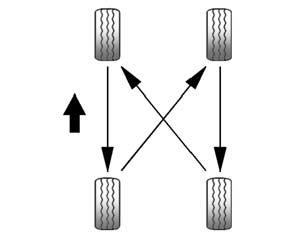
Use this rotation pattern when rotating the tires.
Do not include the compact spare tire in the tire rotation.
Adjust the front and rear tires to the recommended inflation pressure on the Tire and Loading Information label after the tires have been rotated.
See Tire Pressure and Vehicle Load Limits.
Reset the Tire Pressure Monitor System. See Tire Pressure Monitor Operation.
Check that all wheel nuts are properly tightened. See “Wheel Nut Torque� under Capacities and Specifications.
Warning
Rust or dirt on a wheel, or on the parts to which it is fastened, can make wheel nuts become loose after time. The wheel could come off and cause an accident. When changing a wheel, remove any rust or dirt from places where the wheel attaches to the vehicle. In an emergency, a cloth or a paper towel can be used; however, use a scraper or wire brush later to remove all rust or dirt.
Lightly coat the center of the wheel hub with wheel bearing grease after a wheel change or tire rotation to prevent corrosion or rust build-up. Do not get grease on the flat wheel mounting surface or on the wheel nuts or bolts.
 Tire Inspection
We recommend that the tires, including the spare tire, if the vehicle has one,
be inspected for signs of wear or damage at least once a month.
Replace the tire if:
The indicators at three or mo ...
 When It Is Time for New Tires
Factors such as maintenance, temperatures, driving speeds, vehicle loading, and
road conditions affect the wear rate of the tires.
Treadwear indicators are one way to tell when it is time for new ...
Other materials:
Customer Satisfaction Procedure
Your satisfaction and goodwill are important to your dealer and to Chevrolet.
Normally, any concerns with the sales transaction or the operation of the vehicle
will be resolved by your dealer's sales or service departments. Sometimes, however,
despite the best intentions of all concerned, ...
Turbocharger Coolant Return Pipe Replacement (LUV)
Turbocharger Coolant Return Pipe Replacement
Callout
Component Name
Preliminary Procedure
Remove the turbocharger. Refer to Turbocharger Replacement.
1
Turbocharger Fastener
Caution: Refer t ...
Water Outlet Installation
Clean the sealing surfaces.
Install the water outlet (2) and a NEW water outlet seal ring (1).
Caution: Refer to Fastener Caution.
Install the 3 water outlet bolts (3) and tighten to 8 Y (71 lb in).
...

0.0092