
Chevrolet Sonic Repair Manual: Throttle Actuator Control (TAC) System Description
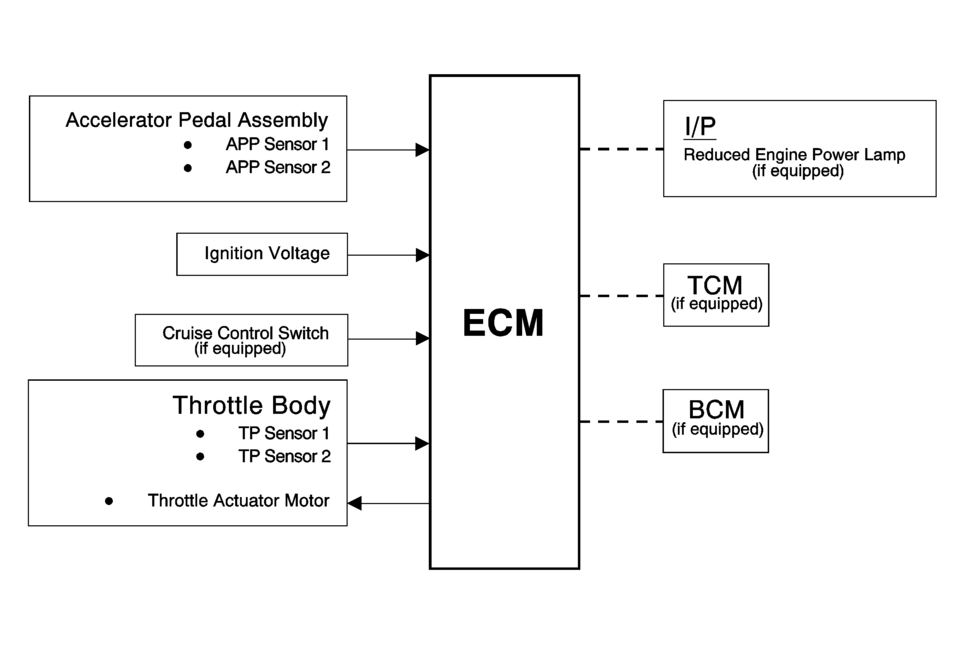
The engine control module (ECM) is the control center for the throttle actuator control (TAC) system. The ECM determines the driver's intent based on input from the accelerator pedal position sensors, then calculates the appropriate throttle response based on the throttle position sensors. The ECM achieves throttle positioning by providing a pulse width modulated voltage to the throttle actuator motor. The throttle blade is spring loaded in both directions, and the default position is slightly open.
- Modes Of Operation
-
Normal Mode
During the operation of the TAC system, several modes, or functions, are considered normal. The following modes may be entered during normal operations:
- Minimum pedal value?t key-up, the ECM updates the learned minimum pedal value.
- Minimum throttle position values?t key-up, the ECM updates the learned minimum throttle position value. In order to learn the minimum throttle position value, the throttle blade is moved to the Closed position.
- Ice break mode?f the throttle blade is not able to reach a predetermined minimum throttle position, the ice break mode is entered. During the ice break mode, the ECM commands the maximum pulse width several times to the throttle actuator motor in the closing direction.
- Minimum pedal value?t key-up, the ECM updates the learned minimum pedal value.
- Battery saver mode?fter a predetermined time without engine RPM, the ECM commands the Battery Saver mode. During the Battery Saver mode, the TAC module removes the voltage from the motor control circuits, which removes the current draw used to maintain the idle position and allows the throttle to return to the spring loaded default position.
Reduced Engine Power Mode
When the ECM detects a condition with the TAC system, the ECM may enter a reduced engine power mode. Reduced engine power may cause one or more of the following conditions:
- Acceleration limiting?he ECM will continue to use the accelerator pedal for throttle control, however, the vehicle acceleration is limited.
- Limited throttle mode?he ECM will continue to use the accelerator pedal for throttle control, however, the maximum throttle opening is limited.
- Throttle default mode?he ECM will turn OFF the throttle actuator motor, and the throttle will return to the spring loaded default position.
- Forced idle mode?he ECM will perform the following actions:
- Limit engine speed to idle positioning the throttle position, or by controlling the fuel and spark if the throttle is turned OFF.
- Ignore the accelerator pedal input.
- Engine shutdown mode?he ECM will disable fuel and de-energize the throttle actuator.

 Throttle Body Assembly Installation
Install a NEW throttle body seal.
Install the throttle body (1).
Caution: Refer to Fastener Caution.
Install the 4 throttle body bolts (2) and tighten to ...
Other materials:
Rear Side Door Window Regulator Handle Replacement
Rear Side Door Window Regulator Handle Replacement
Callout
Component Name
1
Rear Side Door Window Regulator Handle Clip
Procedure
Use the appropriate tool, remove the clip from handle.
2
...
Rear Suspension Description and Operation
This vehicle has a beam rear suspension system consisting of the following components:
An axle with integral trailing arms
A cross beam
Two coil springs
Two standard shock absorbers
Axle Assembly
The axle assembly attaches to the underbody through a rubber bushing and
brac ...
Heater Inlet Hose Replacement (LDE, LUW)
Special Tools
BO-38185 Hose Clamp Pliers
For equivalent regional tools, refer to Special Tools.
Removal Procedure
Drain the cooling system. Refer to Cooling System Draining and Filling.
Disengage the heater inlet hose quick connect clip (1) at the heater
...

0.0072