
Chevrolet Sonic Repair Manual: Tire Rotation
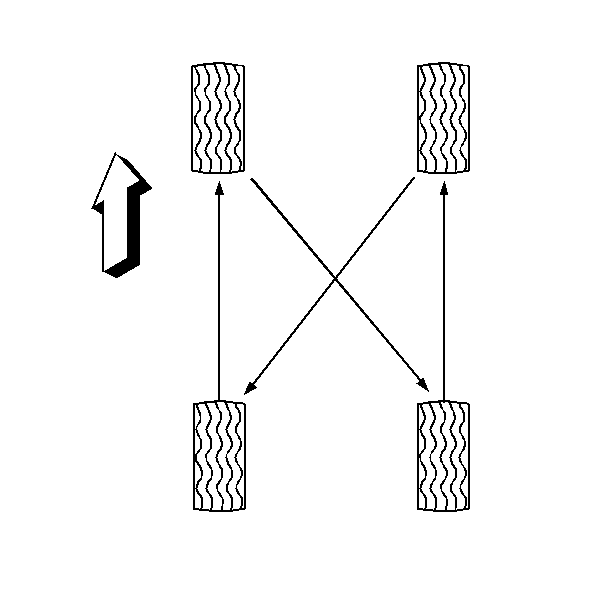
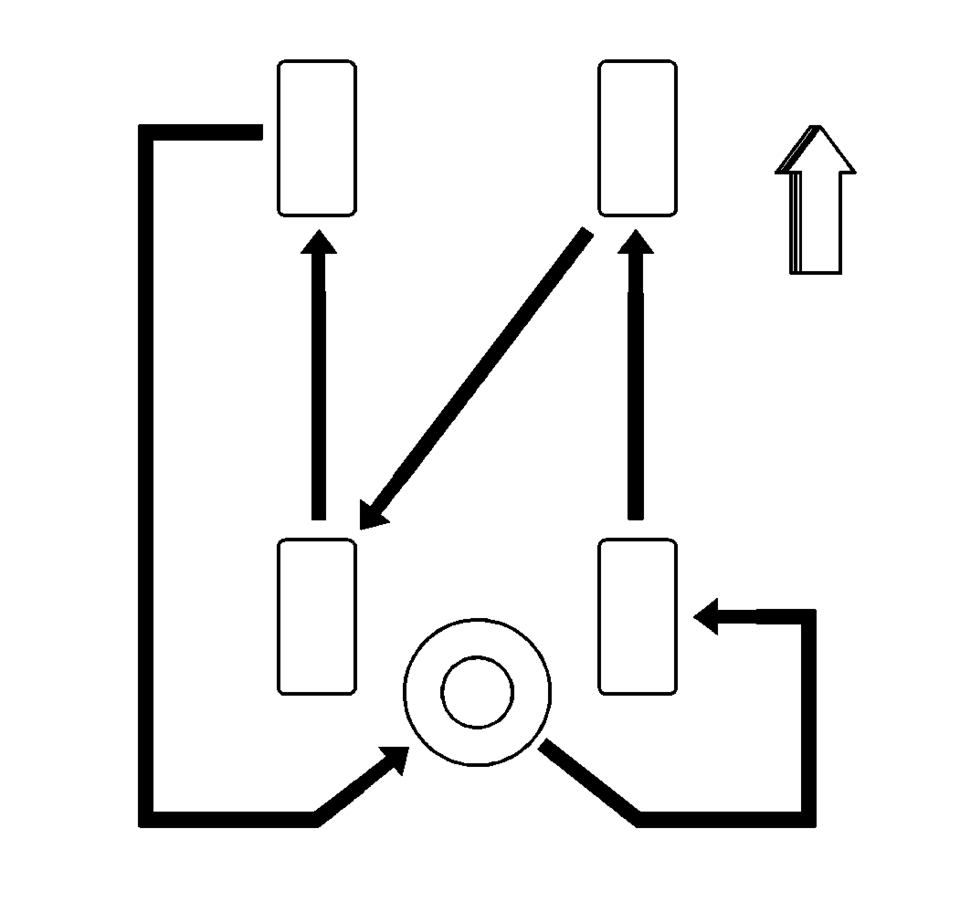
In order to equalize wear, rotate the tires at the specified intervals. Also, rotate the tire and wheel assembly whenever you notice uneven tire wear.
Radial tires tend to wear faster in the shoulder area, particularly in front positions, due to design. Radial tires in non-drive locations may develop an irregular wear pattern that can generate tire noise. This especially makes regular tire rotation necessary.
- Remove the tires and wheels. Refer to Tire and Wheel Removal and Installation.
- For vehicles with single rear wheels (4 tires), rotate the tires as shown.
- For vehicles with single rear wheels (5 tires), rotate the tires as shown.
 Tire Pressure Monitor Operation
This vehicle may have a Tire Pressure Monitor System (TPMS). The TPMS is designed
to warn the driver when a low tire pressure condition exists. TPMS sensors are mounted
onto each tire and wheel as ...
 Tire Terminology and Definitions
Air Pressure
The amount of air inside the tire pressing outward on each square inch
of the tire. Air pressure is expressed in kPa (kilopascal) or psi (pounds per
square inch).
Acc ...
Other materials:
Turbocharger Disassemble
Special Tool
EN-49940 Remover Quick Connector
For equivalent regional tools, refer to Special Tools.
Remove the 2 turbocharger oil return pipe bolts (2).
Remove the turbocharger oil return pipe (1) and the sealing (3) from the
turbocharger.
Note ...
Clutch and Differential Housing Disassemble
Special Tools
M-680770 Universal Sliding Mallet
R-0007758 Holding Fixture
R-0407008 Counter Shaft Bearing Remover
R-0407010 Input Shaft Needle Bearing Puller and Driver
R-0407013 Gearshift Device Bushing Puller
R-0007761 Universal Handle for Pullers and Installers
T-0207928 Retai ...
Motion-activated liftgate
Example
Example
Basic information
The Nissan Armada features a convenient motion-activated liftgate system that
allows hands-free operation using a simple foot gesture beneath the rear bumper.
The kick motion sensor a is positioned on the left side under the rear bumper.
When you per ...

0.1276