
Chevrolet Sonic Repair Manual: Drive Range, Fifth Gear (Gen 2)
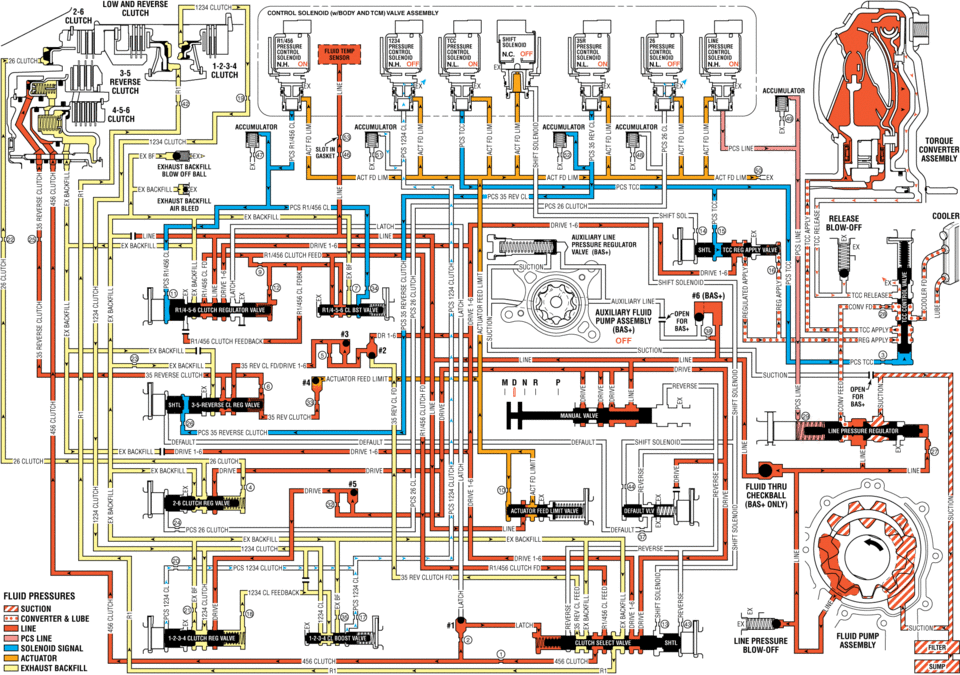
As vehicle speed increases, the transmission control module (TCM) processes input signals from the automatic transmission input and output speed sensors, the throttle position sensor and other vehicle sensors to determine the precise moment to command ON the normally-low 35R pressure control solenoid. At the same time, the normally-high 1234 pressure control solenoid is commanded OFF and the transmission shifts into Fifth gear.
- 3-5-Reverse Clutch Applies
-
35R Pressure Control (PC) Solenoid
The 35R PC solenoid is commanded ON, allowing actuator feed limit fluid to enter the PCS 35 reverse clutch fluid circuit. PCS 35 reverse clutch fluid is routed through orifice #26 to the 3-5-reverse clutch regulator valve.
3-5-Reverse Clutch Regulator Valve
PCS 35 reverse clutch fluid, at the 3-5-reverse clutch regulator valve, opposes 3-5-reverse clutch regulator valve spring force and 35 reverse clutch feedback fluid pressure to regulate 35 reverse clutch feed/drive 1-6 pressure into the 35 reverse clutch circuit. The 35 reverse clutch fluid is then routed through orifice #25 to the 3-5-reverse clutch assembly, through orifice #6 to the spring end of the 3-5-reverse clutch regulator valve and through orifice #33 to the #4 ball check valve.
3-5-Reverse Clutch
35 reverse clutch fluid enters the 3-5-reverse and 4-5-6 clutch housing assembly to move the 3-5-reverse clutch piston against spring force and exhaust backfill fluid pressure to apply the 3-5-reverse clutch plates.
#4 Ball Check Valve
35 reverse clutch feed fluid unseats the #4 ball check valve, allowing excess pressure to pass into the actuator feed limit circuit. This helps to control clutch apply fluid pressure and clutch apply feel.
Accumulator
PCS 35 reverse clutch fluid is also routed to an accumulator valve. The accumulator valve is used to dampen any pressure irregularities occurring in the PCS 35 reverse clutch fluid circuit. This helps to control clutch apply fluid pressure and clutch apply feel.
- 1-2-3-4 Clutch Releases
-
1234 Pressure Control (PC) Solenoid
The 1234 PC solenoid is commanded OFF, allowing PCS 1234 clutch fluid to exhaust from the 1-2-3-4 clutch regulator valve and the 1-2-3-4 clutch boost valve.
1-2-3-4 Clutch Regulator Valve
1-2-3-4 clutch regulator valve spring force moves the valve to the released position, allowing 1234 clutch fluid pressure from the 1-2-3-4 clutch to pass through the valve and enter the exhaust backfill circuit. The exhausting 1234 clutch fluid pressure is routed through orifice #21 in order to help control the release of the 1-2-3-4 clutch.
1-2-3-4 Clutch Boost Valve
1-2-3-4 clutch boost valve spring force moves the 1-2-3-4 clutch boost valve to the released position, allowing 1234 clutch feedback fluid pressure to exhaust from the 1-2-3-4 clutch regulator valve into the 1234 clutch circuit.
1-2-3-4 Clutch
1-2-3-4 clutch spring force moves the 1-2-3-4 clutch piston to release the 1-2-3-4 clutch plates and force 1234 clutch fluid to exhaust from the transmission case assembly. The exhausting 1234 clutch fluid is routed to the 1-2-3-4 clutch regulator valve where it enters the exhaust backfill circuit.
- Drive Range, Fifth Gear ?#8201;Gen 2/Hybrid
ldw and reverse clutch z-6 [;_un;h ass7em7blv ms pres pre press pressure n.h. un off clutch ex ex ex ex clutch tdrdue converter assemnlv arr ball act fd ex exnaust backfill airbleed release ex badkhll clutch feed line auxiliary fluid (bas+) clutch feedback off ex ii sucnuu lwe 35 reverse clutch feed rev clutch sulenoid :ex -drive drive fluid thru ehedkball pcszg clutch ume default ex ex backhll clutch reverse pcs clutch mass rev fd fluid pnessunes sucnou couverrer lube line line pressure solenoid signal actuator :i exhaust
 Drive Range, Fifth Gear (Gen 1)
As vehicle speed increases, the transmission control module (TCM) processes input
signals from the automatic transmission input and output speed sensors, the throttle
position sensor and other veh ...
 Drive Range, Fifth Gear Default (Gen 1)
If the transmission encounters an electrical component malfunction, the transmission
will default to Fifth gear. All solenoids will default to their normal state. If
the torque converter clutch is ...
Other materials:
When the System Does Not Seem To Work Properly
If the LDW symbol does not appear:
The lane markings on the road may not be seen.
The camera sensor may be blocked by dirt, snow or ice.
The windshield may be damaged.
The weather may be limiting visibility.
This is normal operation; the vehicle does not need service. Clean the windshie ...
Home Page (Radio with Touchscreen)
Touchscreen Buttons
Touchscreen buttons show on the screen when available. When a function is
unavailable, the button may gray out. When a function is selected, the button
may highlight.
Home Page Features
audiopicturemovietelephoneelsmartphonelinksettings03/06/2012
...
Thrust Angles Description
The front wheels aim or steer the vehicle. The rear wheels control tracking.
This tracking action relates to the thrust angle (3). The thrust angle is the path
that the rear wheels take. Ideally, the thrust angle is geometrically aligned with
the body centerline (2).
In the i ...

0.005