
Chevrolet Sonic Repair Manual: Oil Pan Installation
Special Tools
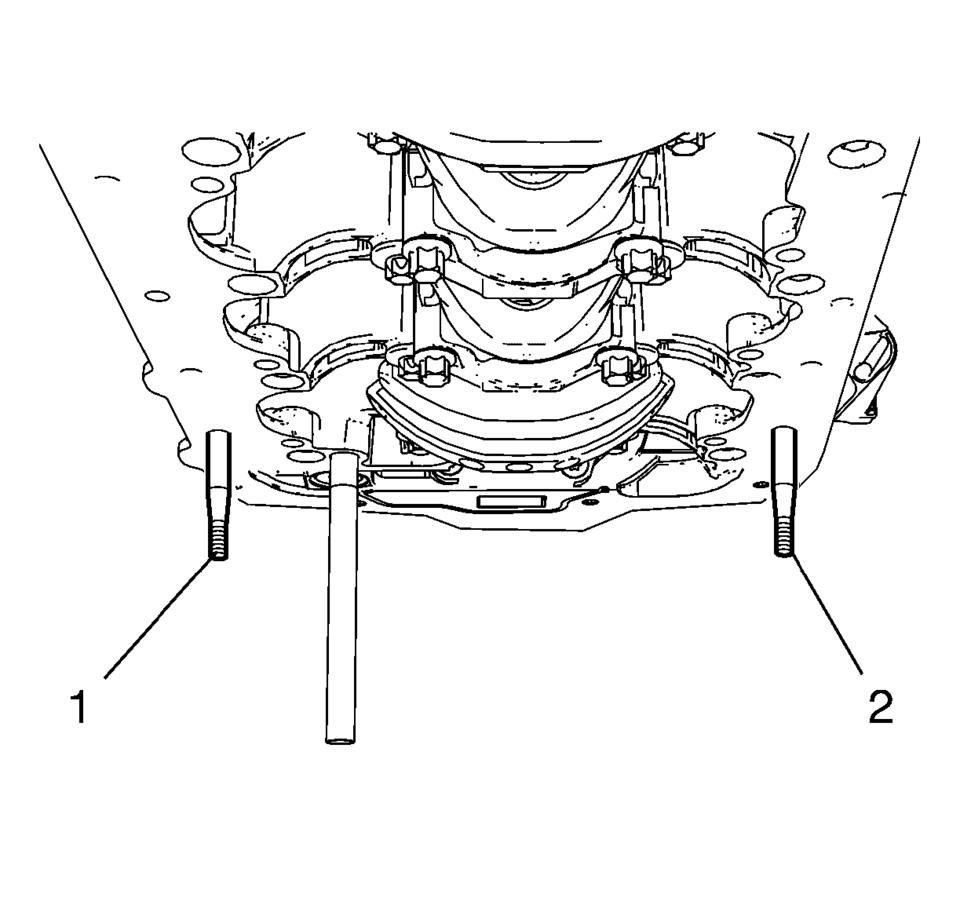
EN-49980 Guidance Pins
For equivalent regional tools, refer to Special Tools.
- Clean the sealing surfaces from old sealing material, dirt, oil and grease.
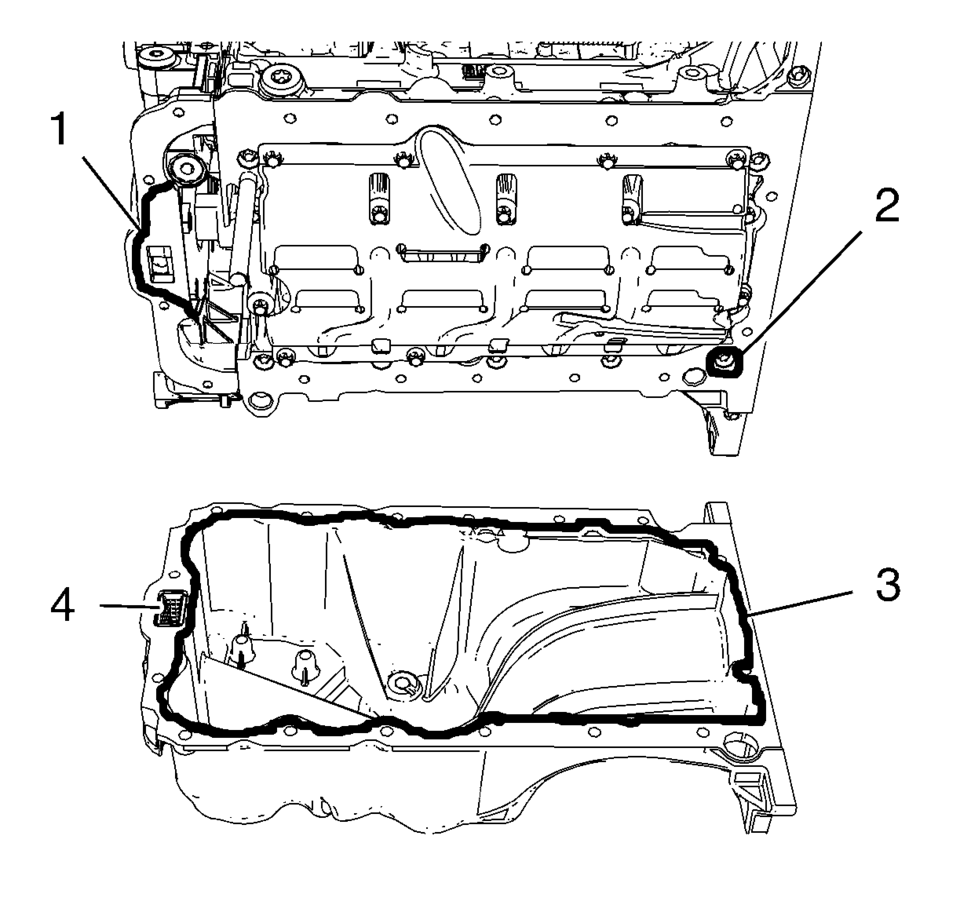
- Apply sealing compound to the oil pan. Refer to Adhesives, Fluids, Lubricants, and Sealers.
- Apply sealing compound to the groove of the engine front cover (1). Refer to Adhesives, Fluids, Lubricants, and Sealers.
- Apply sealing compound around the screw bore (2) of the crankshaft bearing cap tie plate.
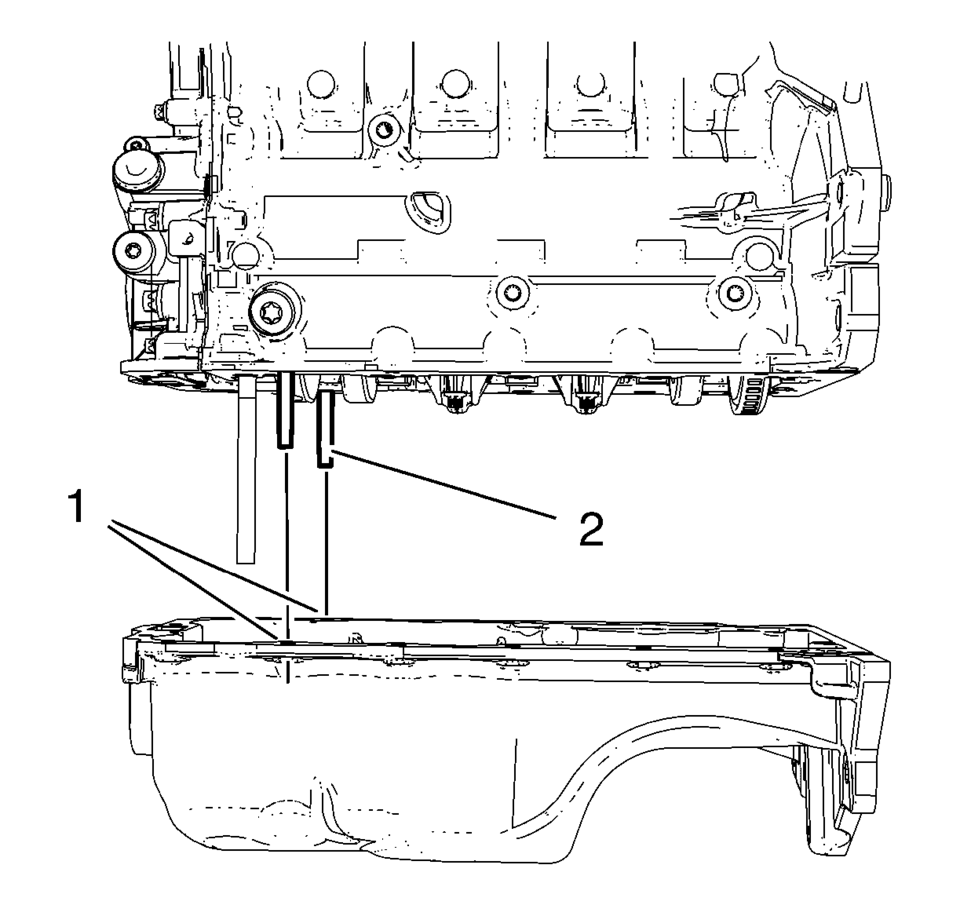
- Install the 2 EN-49980 pins (1) and (2) to the shown oil pan screw bores.
- Carefully install the oil pan. Guide the oil pan with EN-49980 pins (2) and the equivalent screw bores (1).
- Hold the oil pan with 4 oil pan bolts.
- Remove EN-49980 pins.
- Install the remaining 12 oil pan bolts and hand tighten.
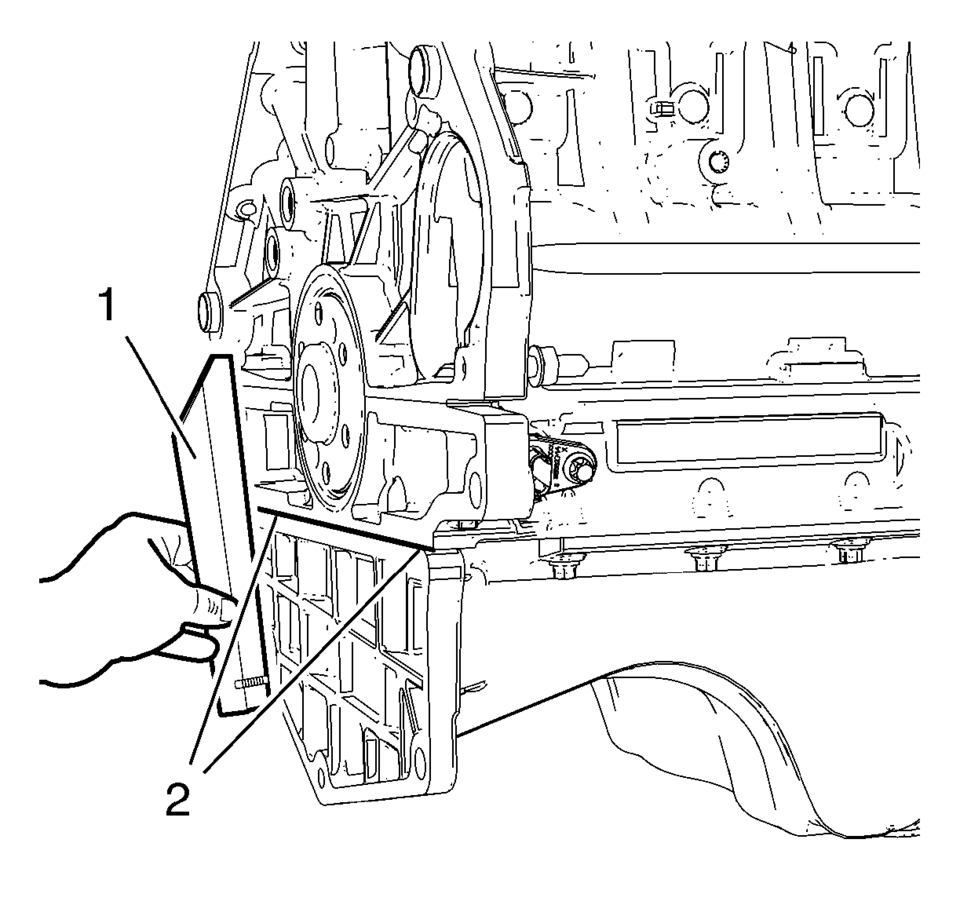
- Lay a straight edge (1) against the oil pan and engine block. Using a rubber mallet, adjust the transition in area (2) until there is no clearance between oil pan and the straight edge.
- Tighten the 16 oil pan bolts to 10 Y (89 lb in)
.
Note:
The sealing bead should be applied close to the inner edge of the oil pan. Take care that the oil suction gallery (4) will not get contaminated with sealing compound or dirt. The thickness of the sealing bead (3) should be 2 mm (0.0787 in).
Note:
The complete installation procedure of the oil pan should not take longer than 10 minutes.
Caution:
Use care when installing the oil pan to prevent disruption of the sealing bead. The sealing bead should remain consistent until the oil pan is mated with the engine. An inconsistent sealing bead can cause an insufficient seal and result in engine damage.
Caution:
Refer to Fastener Caution.
 Oil Pan Cleaning and Inspection
Warning: Wear safety glasses when using compressed air in order
to prevent eye injury.
Caution: To ensure proper engine lubrication, clean clogged or
contaminated oil ga ...
 Oil Pan Removal
Remove the 16 oil pan bolts (1).
Caution: Pry the oil pan carefully in order to prevent damage
to the transaxle case or the oil pan sealing surfaces.
Place a ...
Other materials:
Dome Lamps
The dome lamp controls are in the headliner above the rear seats.
(Dome Lamp Override): Press to turn
the lamps off, even when a door is open.
(Door): When the button is returned
to the middle position, the lamps turn on automatically when a door is opened.
| (On): Press to turn on the dom ...
Crankshaft Position System Variation Learn
Note: The crankshaft position sensor system variation learn procedure
is required when the following service procedures have been performed, regardless
of whether DTC P0315 is set:
Engine replacement
Engine control module (ECM) replacement
Crankshaft damper replacement
...
Drive Range, Fifth Gear Default (Gen 2)
If the transmission encounters an electrical component malfunction, the transmission
will default to Fourth gear. All solenoids will default to their normal state. If
the torque converter clutch is applied, it will release. The transmission will remain
in Drive Range?Fourth Gear Default until ...

0.0073