
Chevrolet Sonic Repair Manual: Front Brake Caliper Overhaul
- Disassembly Procedure
-
Warning:
Refer to Brake Dust Warning.
Warning:
Refer to Brake Fluid Irritant Warning.
- Remove the brake caliper from the vehicle. Refer to Front Brake Caliper Replacement.
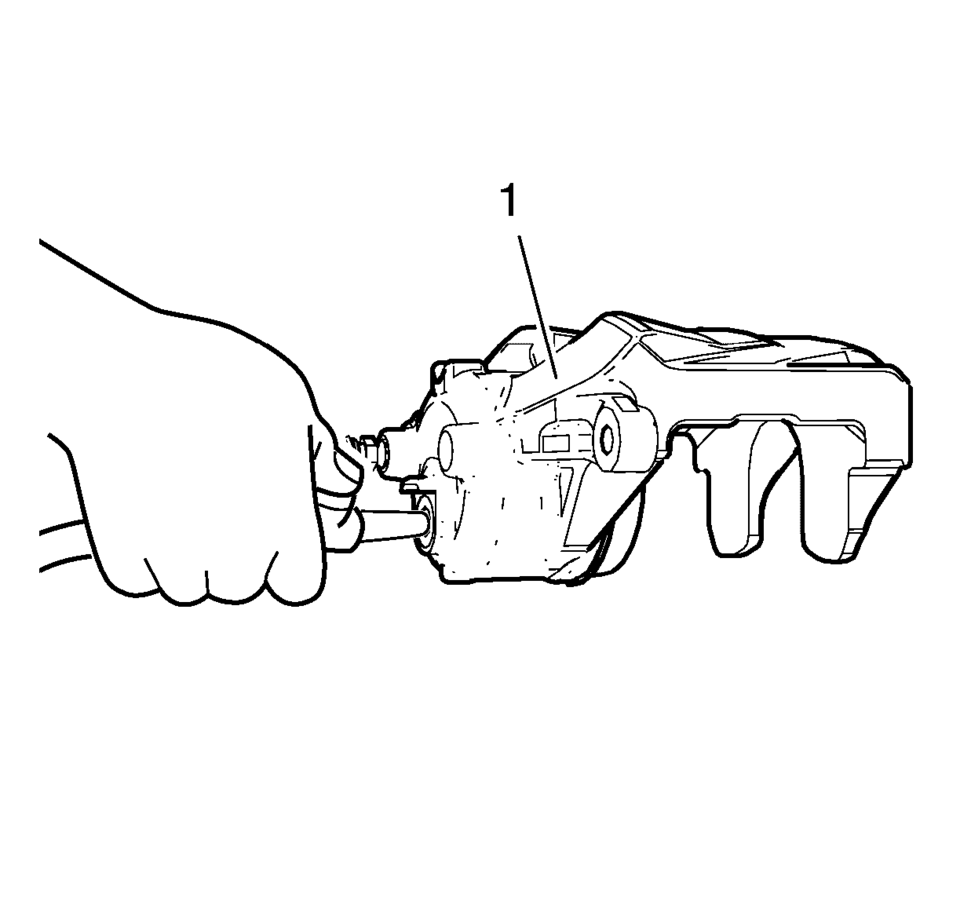
- Remove the brake caliper piston from the caliper bore by directing low
pressure compressed air into the caliper (1) through the fluid inlet hole.
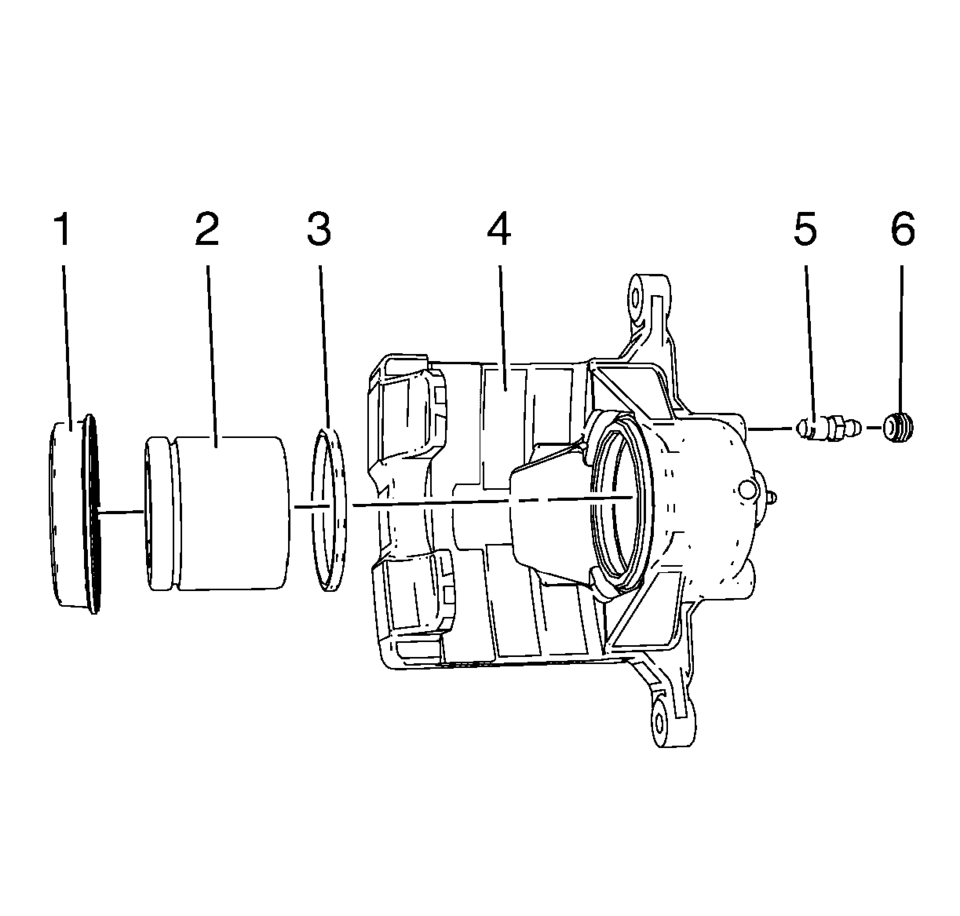
- Remove the piston dust boot seal (1) from the seal counterbore in the caliper (4). Discard the boot seal.
- Using a small wooden or plastic tool, remove the piston seal (3) from the caliper bore. Discard the piston seal.
- Remove the bleeder valve cap (6).
- Remove the bleeder valve (5).
- If cracks, scoring, pitting, excessive rust, and/or excessive corrosion are present in the caliper bore, replace the caliper assembly.
- If light rust or light corrosion are present in the caliper bore, attempt to remove the imperfection with a fine emery paper. If the imperfection cannot be removed, replace the caliper assembly.
- Clean the brake caliper piston bore and seal counterbore, and the caliper piston with denatured alcohol, or equivalent.
- Dry the caliper piston bore and counterbore, and the piston with non-lubricated, filtered, compressed air.
- Inspect the caliper piston for cracks, scoring, and/or damage to the plating. Replace the caliper piston if any of these conditions exist.
- Inspect the caliper mounting holes for cracks, scoring, pitting, rust and/or excessive corrosion. Replace the caliper assembly if any of these conditions exist.
Warning:
Do not place fingers in front of the caliper piston(s) in an attempt to catch or protect it when applying compressed air. The piston(s) can fly out with force and could result in serious bodily injury.
Caution:
Use clean cloths to pad interior of caliper housing during piston removal. Use just enough air to ease the pistons out of the bores. If the pistons are blown out, even with the padding provided, it may be damaged.
Note:
Do not use abrasives to clean the brake caliper piston.
- Assembly Procedure
-
- Lubricate the new piston seal (3) with brake fluid from a clean, sealed brake fluid container.
- Install the lubricated, new piston seal into the caliper bore.
- Apply a thin coat of brake fluid from a clean, sealed brake fluid container.
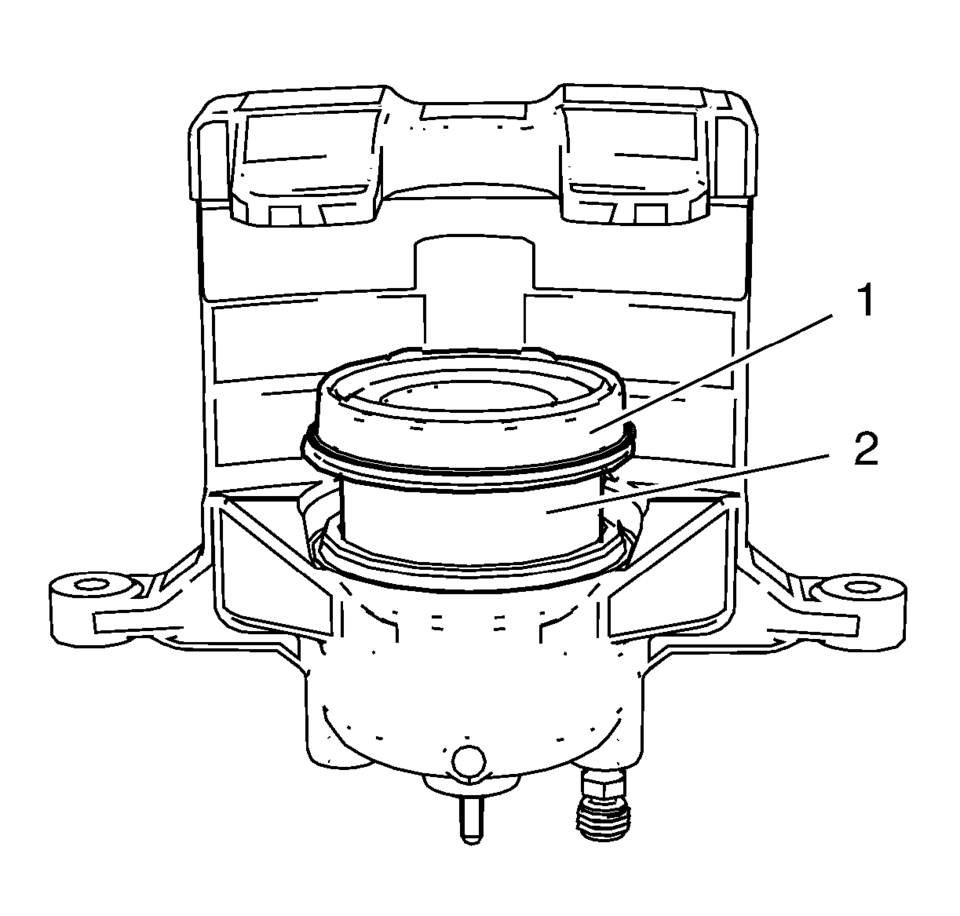
- Install the new piston dust boot seal (1) over the caliper piston (2).
- Install the bottom half of the caliper piston into the caliper bore.
- Compress the caliper piston to the bottom of the caliper bore.
- Fully seat the piston dust boot seal into caliper counterbore.
- Install the bleeder valve to the caliper.
Caution:
Refer to Fastener Caution.
- J93, J94: Tighten the valve to 17 Y (13 lb ft)
- JPW, J97: Tighten the valve to 9 Y (80 lb in)
- Install the bleeder valve cap.
- Install the brake caliper to the vehicle. Refer to Front Brake Caliper Replacement.
 Front Brake Caliper Bracket Replacement
Removal Procedure
Warning: Refer to Brake Dust Warning.
Raise and support the vehicle. Refer to Lifting and Jacking the Vehicle.
Remove the tire and wheel assembly. Refer ...
 Front Brake Caliper Replacement
Removal Procedure
Warning: Refer to Brake Dust Warning.
Warning: Refer to Brake Fluid Irritant Warning.
Raise and support the vehicle. Refer to Lifting and Jacking the ...
Other materials:
Front Wheel Drive Intermediate Shaft Replacement
Front Wheel Drive Intermediate Shaft Replacement
Callout
Component Name
Preliminary Procedure
Raise and support the vehicle. Refer to Lifting and Jacking the
Vehicle.
Remove the wheel drive shaft assembly from the vehicle ...
Throttle Body Heater Inlet Hose Replacement (LUW)
Throttle Body Heater Inlet Hose Replacement
Callout
Component Name
Preliminary Procedure
Remove the air cleaner outlet duct. Refer to Air Cleaner Outlet
Duct Replacement.
Drain the cooling system. Refer to Cooling System ...
Headlight and turn signal switch
Headlight switch
Basic information
CAUTION
In the Nissan Armada, always operate the headlights with the engine running
to prevent unnecessary battery discharge and ensure reliable electrical system performance.
Example
Lighting
Type A (if so equipped):
Rotate the switch to the
...

0.0064