
Chevrolet Sonic Repair Manual: Heated Oxygen Sensor Replacement - Sensor 1
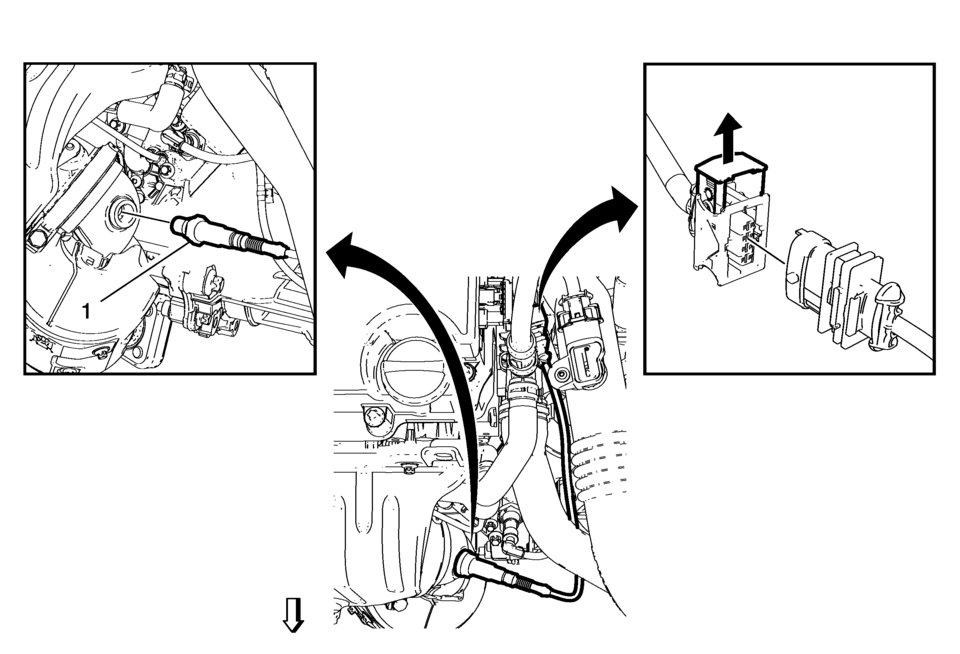
|
Callout |
Component Name |
|---|---|
|
Warning: In order to avoid being burned, do not service the exhaust system while it is still hot. Service the system when it is cool. Preliminary Procedure
Disconnect battery negative cable. Refer to Battery Negative Cable Disconnection and Connection. |
|
|
1 |
Heated Oxygen Sensor 1 Caution: Refer to Component Fastener Tightening Caution.
42 Y(31 lb ft) Special Tools
EN-48259 Installer/Remover For equivalent regional tools, refer to Special Tools |
 Knock Sensor System Description
Circuit/System Description
The knock sensor system enables the engine control module (ECM) to control
the ignition timing for the best possible performance while protecting the engine
...
 Heated Oxygen Sensor Replacement - Sensor 2
Heated Oxygen Sensor Replacement - Sensor 2
Callout
Component Name
1
Heated Oxygen Sensor 2
Warning: In or ...
Other materials:
Sunroof Housing Rear Drain Hose Replacement
Sunroof Housing Rear Drain Hose Replacement
Callout
Component Name
Preliminary Procedures
It is only necessary to lower the headliner. Only do those steps
in the headliner replacement procedure that will lower the headliner
...
Fuel System Description
Fuel System Overview
The fuel system is an electronic returnless on-demand design. A returnless
fuel system reduces the internal temperature of the fuel tank by not returning
hot fuel from the engine to the fuel tank. Reducing the internal temperature
of the fuel tank results in lo ...
Driver and front passenger supplemental knee air bag
Driver's side
In the Nissan Armada, the supplemental knee air bags are strategically positioned
within the lower dashboard area, also known as the knee bolster, on both the driver
and front passenger sides. These systems are an integral part of the overall Supplemental
Restraint Syste ...

0.005